Multi-Agent Collaboration for Robotics
Client: Griffith University with QDSA
Scope: TRL 3 → 6
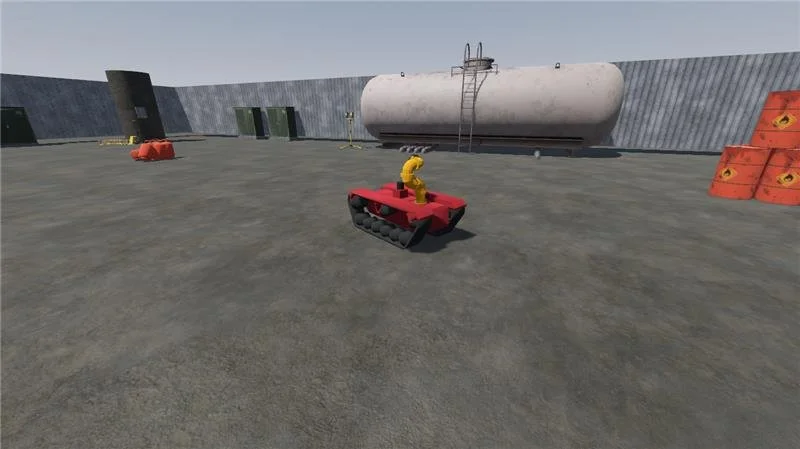
Deep reinforcement learning (DRL) developed for the control of mobile robot teams within the context of navigation and task-based collaborative scenarios. We applied a DRL policy with a tailored neural network architecture as a solution to control, path planning, and higher-level guidance tasks.
Our network architecture was trained using a unique multi-stage curriculum that progresses from single-agent navigation, to multi-agent pathfinding with obstacles, and finally to a complex collaborative firefighting scenario.
This structured approach accelerates training convergence by systematically building sophisticated collaborative behaviours upon foundational skills, which enhances training stability and guides the agents towards learning effective and coordinated strategies The policy evaluation was conducted in both simulation and hybrid simulation-physical demonstrations utilising a real unmanned ground vehicle (UGV).
The project involved building a physics based digital twin in order to train the reinforcement model with a suitable learning rate and reward function. This allowed for full Monte Carlo simulations with behaviours developed as part of this process.
The use cases for this include task prioritization of multi-agent systems such as:
Final mile logistics of multiple items to multiple locations
Synchronized and coordinated fires
Swarming to overwhelm a defensive system with task reallocation based on attrition
Multi- platform collaboration when one systems sensors / effectors is inadequate to fully achieve the mission
Further information on the project can be found here.