
Proven Autonomy
Adapted to Your Platform
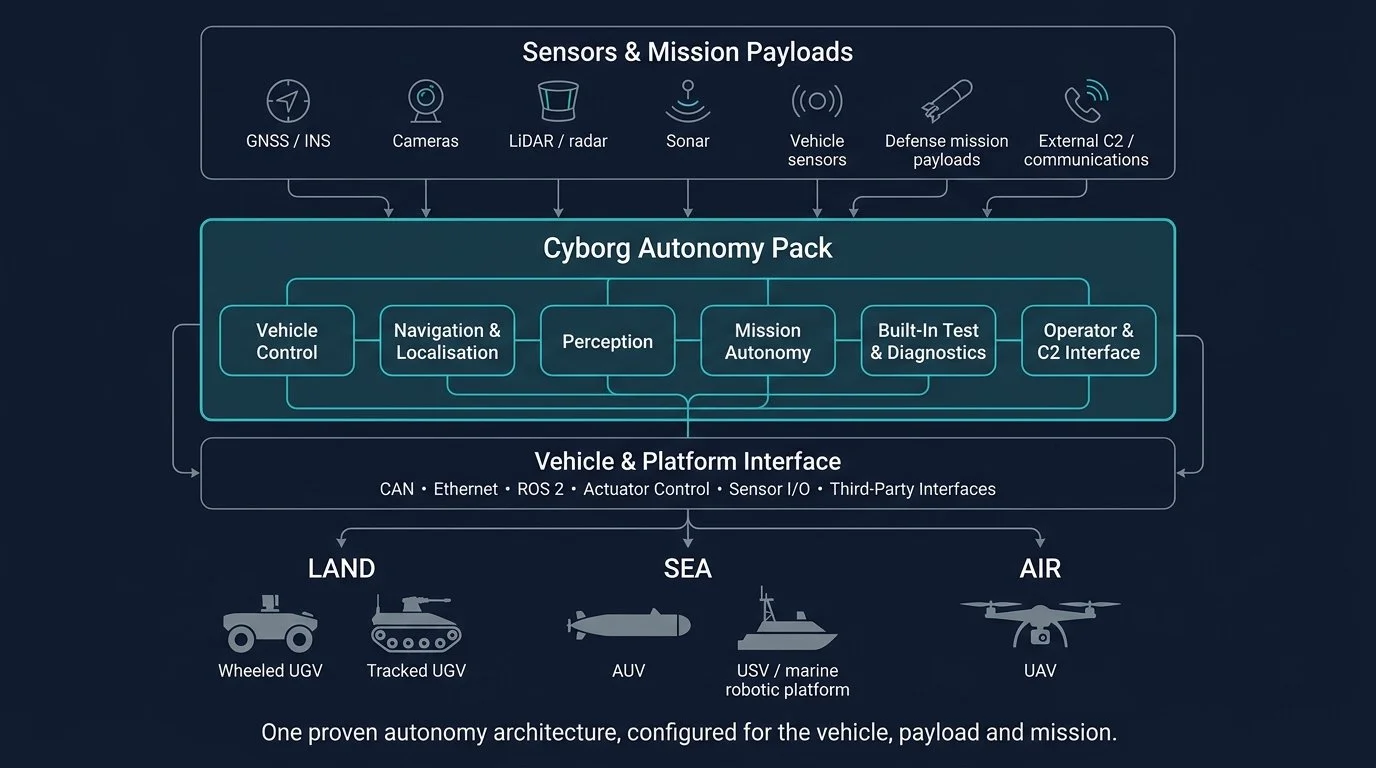
The Cyborg Autonomy Pack
Developed through years of operating autonomous systems in real environments, the Cyborg Autonomy Pack brings together vehicle control, navigation, diagnostics, perception and payload integration in a reusable architecture.
What seven years of field operation taught us
Our autonomy stack has been refined through years of driver feedback, vehicle testing and real-world deployment. The result is a set of practical capabilities designed around how autonomous vehicles actually behave in the field.
GNSS-Denied Localisation
Keep operating when GPS cannot be trusted.
Inertial navigation incorporating vehicle motion and wheel-slip compensation to maintain useful localisation in degraded and GNSS-denied environments.
Vehicle Tether
Controlled movement without full autonomy.
Tethered vehicle movement for loading, unloading, convoy-style operations and environments where communications or navigation may be contested.
Vehicle-Aware Speed Control
Autonomous driving that respects the vehicle.
Speed modes account for steering behaviour, turning radius, vehicle dynamics and driveability constraints rather than relying on simple velocity commands.
Waypoint Navigation
Navigation tuned on physical vehicles.
Waypoint tracking and path-following algorithms refined through repeated field testing across changing terrain, speeds, vehicles and payload configurations.
Terrain Assessment
Understand where the vehicle can actually go.
Terrain mapping supports autonomous and driver-assist go/no-go assessment, helping identify areas outside the vehicle's practical mobility envelope.
Complex Drivetrain Control
Autonomy beyond conventional steering.
Control architectures for skid-steer, tracked, differential and other non-Ackermann vehicle configurations.
Built-In Test & Diagnostics
Know the system is ready before the mission.
Integrated health monitoring, fault reporting, logging and diagnostics improve field maintainability and make faults easier to identify before and during operation.
Defence Payload Integration
The platform must perform the mission, not just drive itself.
Integration of sensors, communications, ISR systems, masts, remote systems and other mission payloads with vehicle control and autonomy.
Built for real platforms, not just simulation.
Our autonomy systems are built around the practical challenges of deploying, operating and supporting robotic vehicles in the field. We combine reusable autonomy software with platform-specific engineering to deliver systems that work with the vehicle, payload and mission.
Field Proven
Developed through hundreds of hours of real vehicle operation, with software refined from driver, operator and field-test feedback.
Platform Independent
Reusable autonomy components are adapted to the vehicle dynamics, drivetrain, sensors and mission rather than being tied to one specific platform.
Payload Aware
Vehicle autonomy, mission systems and payloads are engineered as one system, enabling the platform to move in support of the mission rather than simply follow a route.
Integration Ready
Designed to connect with existing robotics, vehicle and mission ecosystems using standard interfaces such as CAN, Ethernet, ROS 2 and third-party APIs.
Integrate with the technologies already on your platform.
The Cyborg Autonomy Pack can work alongside existing vehicle electronics, autopilots, sensors and customer systems rather than requiring an entirely new technology stack.
Proven across real platforms and environments.
Our autonomy capability has been developed through practical vehicle programs spanning land, underwater and aerial systems.

Warfighter Uncrewed Ground Vehicle
Development and operational testing of an autonomous ground vehicle incorporating vehicle control, navigation, perception and mission payload integration.

Autonomous Underwater Systems
Controls, navigation, ROS architecture, collision avoidance and vehicle simulation developed for autonomous underwater survey and inspection applications.

UAV Guidance & Terminal Control
Guidance, navigation and control development for aerial systems, including flight-control integration, simulation and proportional navigation for terminal-guidance applications.
Cyder - Our Enabling Hardware
Cyder is a suite of modular components developed from our own experience building robotics systems. Now available as off-the-shelf products, Cyder is designed to simplify integration and accelerate product development for other robotics companies.
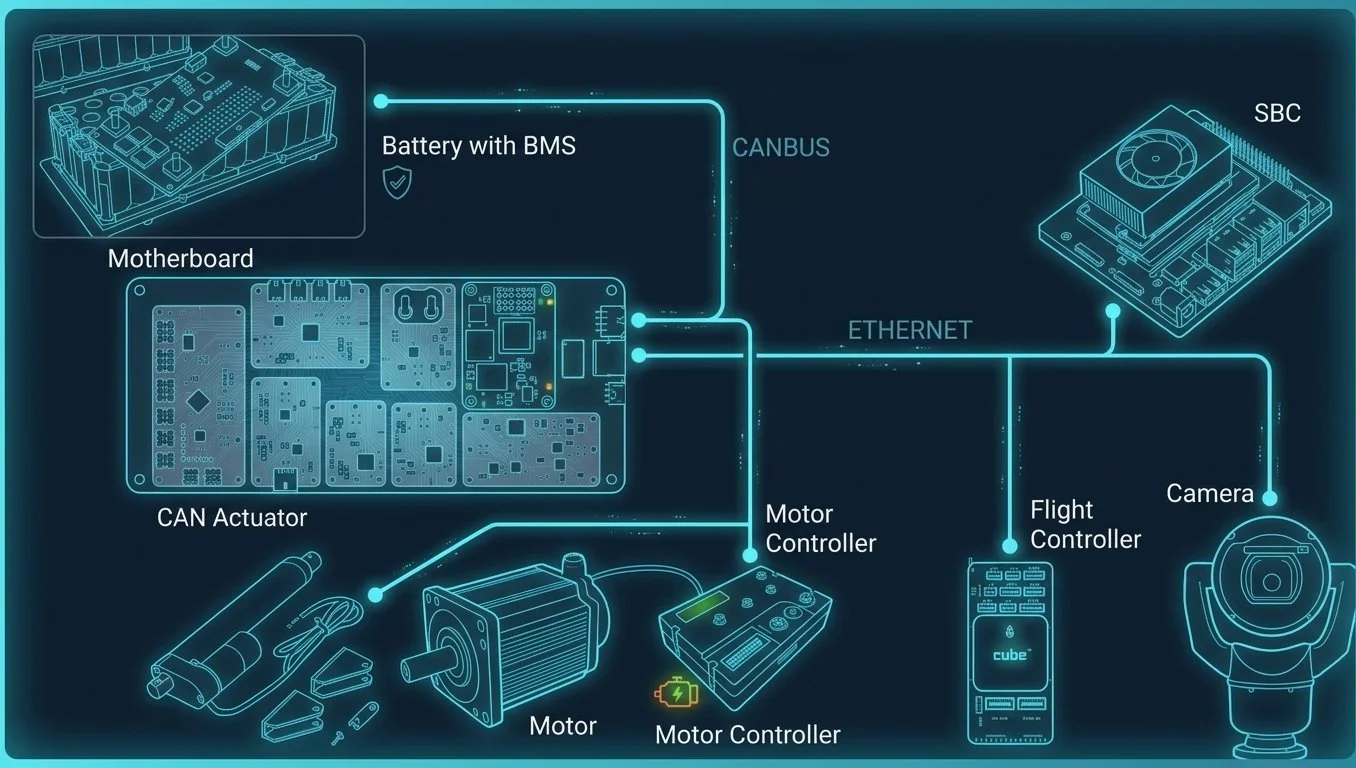
Each module uses a motherboard-mountable architecture to minimise wiring while maintaining flexibility and serviceability, with robust automotive-grade power and data connections. Modules communicate over a centralised CAN bus, enabling streamlined system integration, diagnostics, logging, and debugging through our CyderVis CAN analysis software.
Compatible With


Connection Diagram
Battery Management System Solutions
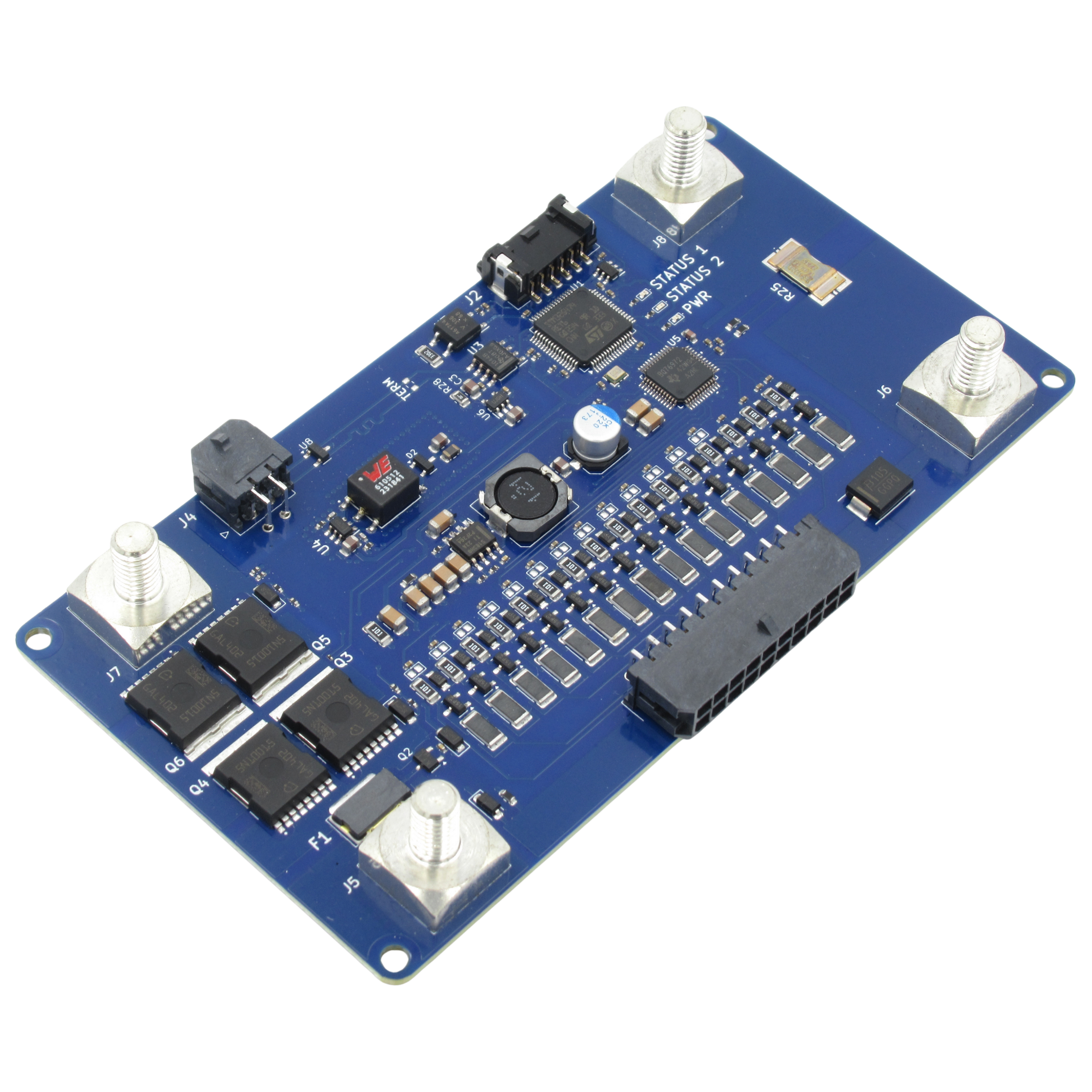
We provide off-the-shelf or bespoke solutions for Li-Ion and LiFePO4 batteries, with features including short-circuit protection, current-measurement, state of charge estimation, cell balancing, isolated serial comms, and more.
Integration Examples
Unmanned Ground Vehicles

Unmanned Surface Vehicles
Autonomy FAQs
-
A CAN bus is low cost, highly resistant to electrical noise, and lets critical safety messages pass through instantly without a central computer. The CAN bus supports plug and play components for specific use cases like retrofitting crewed platforms.
-
Sparkfun kits are not industrial rated, often use comms which are susceptable to electrical noise, and lack compliance to automative power protection which Cyder offers. Our codebase is RUST based providing memory safety for mission critical applications.
-
Yes, we can connect our bus to a Pixhawk or CUBE autopilot allowing for GPIO expansion and specialisation, whilst leveraging CUBEs autopilot software and in built sensor stack.
-
The modules for the job are selected for a robotics retrofit, often using the loaded motherboard, as well as various tilt sensors, proximity switches and actuators. Some equipment already has a central CAN bus allowing direct control of system actuators.
-
Prices for components start at hundreds of dollars with a full evaluation kit including motherboard starting at $1000.
From existing vehicle to autonomous platform.
We combine proven autonomy components with platform-specific engineering to convert existing vehicles and robotic systems into deployable autonomous platforms.
Assess
Understand the platform, mission and operating environment.
We assess vehicle dynamics, drivetrain, payloads, sensors, communications, safety constraints and the required level of autonomy.
Integrate
Connect autonomy to the vehicle and mission systems.
We integrate actuators, steering, propulsion, sensors, payloads, communications and existing vehicle electronics using suitable interfaces.
Configure
Adapt proven autonomy to the specific platform.
Control, localisation, navigation, perception and mission behaviours are configured and tuned for the vehicle dynamics and operational requirements.
Validate
Progressively prove the system before deployment.
Development progresses through simulation, bench testing, controlled vehicle trials and representative field testing to reduce technical and operational risk.
Deploy
Move from engineering prototype to operational system.
We support deployment with system diagnostics, operator training, documentation, field engineering and ongoing capability development.