
Spinning Wheels…
Are we failing to apply land maneouvre lessons learned over the last 100 years?
Choosing the Right UGV for the Terrain is no different to picking a rifle from the Armoury
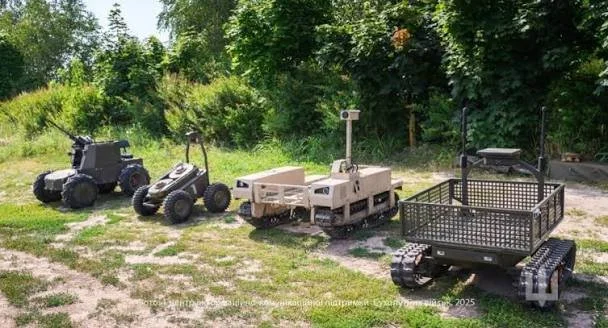
Ukraine UGVs catalogued in the Brave1 ecosystem
All too often we hear the wheels vs tracks vs legs debate. It isn’t a debate unfortunately and pretty well established after 100 years of land based combat with clear roles for mobile infantry, mechanized infantry and dismounted infantry.... This can directly apply to UGVs, however somewhere this was lost in a lack of technical understanding, insights and posting cycles. This has limited maneuver corporate knowledge within defence capability development and acquisition agencies, often resulting in programs ‘spinning wheels’.
When a soldier steps into the armoury before a deployment, they don’t grab a single, one-size-fits-all firearm. They assess the mission profile, intelligence reports, enemy weapons systems, likely threat.
Heading into dense urban close-quarters with a threat that doesn’t wear body armour? They pick a short-barreled carbine for maneuverability. Operating in open, mountainous terrain where long-range engagement is vital? They reach for a designated heavy calibre marksman rifle or direct fire HE for engaging armor. Navigating complex rubble or highly restricted stairwells where a rifle is too cumbersome? They might rely on a specialized pistol or a dynamic entry tool like shotgun.
The exact same logic applies to deploying Unmanned Ground Vehicles (UGVs) across the rugged, unpredictable theater of the Indo-Pacific. Defense planners must view UGVs as a diverse toolkit where wheels, tracks, and legs each serve a distinct tactical purpose.
So what platform do you pick from the armoury and when?
The Tactical Armoury Mindset: Three Specialized Classes
Wheeled UGVs (The Standard-Issue Fitout):
Across most inventories, wheeled platforms serve as the default baseline. They are fast, mechanically simple, and efficient on hard-packed surfaces, making them the standard choice for routine patrols, logistics along established roads, and base perimeters. But if you take standard gear into an environment it wasn't built for, like forcing wheels into saturated tropical soils, deep mud, or volcanic ash their advantages vanish as they bog down and spin out.
This was evident at the Xtech Strike Ground event in Germany when a number of wheeled systems struggled with heavily undulated and soft terrain. Can you plan for this as a commander? Yes. But in some circumstances you will want an increased envelope of operations.
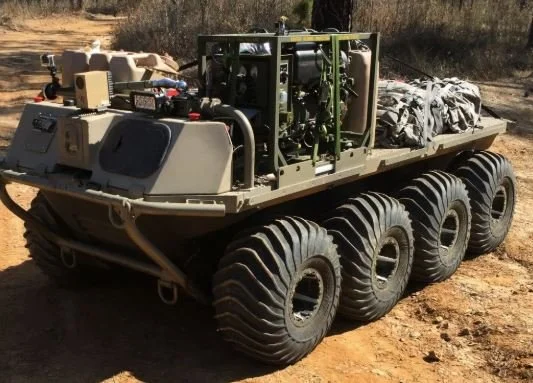
General Dynamics MUTT - Largest NATO UGV Fielding prior to Ukraine
They also struggle in dense close quarters due to difficulty in stair climbing. Hence why most Explosive Ordinance Disposal robots have historically been tracked.
What about a ‘track kit’ that goes over wheels? This works in lower torque applications such as low speed, fairly flat, minimal payload and minimal side slip / skid steering. This is due to in high torque applications the wheel to belt interaction is unable to perform the torque transfer necessary, due to track tensioning requirements of any track design (possible with tensioners to some extent). Furthermore without sprocket and idler geometry the risk of detracking a design like this is much higher.
The other option is adding more wheels (6-8) which provides a compramise between ground pressure, speed and affordability at the cost of skid steering friction. This is very popular across utility UGV applications required to carry significant loads, whilst also able to achieve decent top speeds such as HDT Hunter Wolf, Rheinmetal Mission Master and General Dynamics SMET.
Tracked UGVs (The Heavy Terrain Specialists):
Engineered specifically for punishing environments where standard platforms fail. Tracked platforms are purpose-built for heavy terrain, soft soils, littoral transition, rockey inclines, and complex operations. They distribute weight evenly to prevent sinking, chew through thick mud, climb over rubble or fallen logs, and pivot in tight soft environments.
Their primary disadvantages is cost, speed, and maintenance. In general the additional moving parts mean more maintenance, higher production cost and reduced drive train efficiency. As such tracked vehicles are best for carrying heavy payloads in complex terrains.
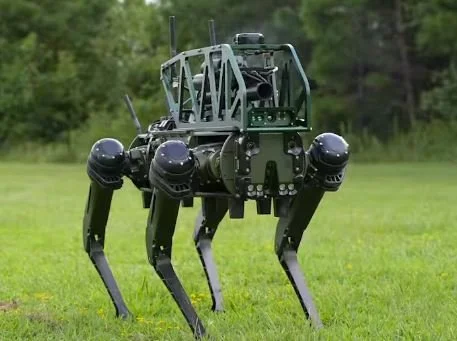
Skyborne Technologies CODIAQ Armed Quadraped
Quadraped / Legged UGVs (The Agile Vertical Specialists):
Representing the most adaptive tier of mobility, quadruped "robot dogs" are built for environments that completely defeat both wheels and tracks. When the mission moves away from horizontal surfaces and into high-rise urban rubble, dense jungle trails, subterranean, tight corners, quadrupeds step in. Their articulated legs allow them to step over complex obstacles, crawl through narrow apertures, and maintain stability where continuous tracks or wheels would high-center.
Quadrapeds suffer from a high production costs, slowest speeds and smallest payload to base weight as well as endurance. As such these are highly specialized systems to go locations where wheeled and tracked systems can’t go, they are designed to deliver a very specific, precision effect.
Mission Success Starts with Terrain Matching
In the diverse landscapes of the Indo-Pacific, spanning paved military installations, dense jungles, riverines, loose coastal sands, and vertical urban ruins, commanders cannot rely solely on a single load carriage solution.
Treating UGVs like tactical gear means matching the platform directly to the geography:
Use wheeled systems as the standard fitout for roads, firm open ground and hard surfaces as well as lightly undulating terrain.
Deploy tracked systems when heavy payloads combine with soft soils and / or steep inclines such as 30-40% gradient, stairs etc.
Unleash quadrupeds when the mission calls for agility across vertical obstacles, stairs, and broken, multi-level terrain, to deliver a precision effect.
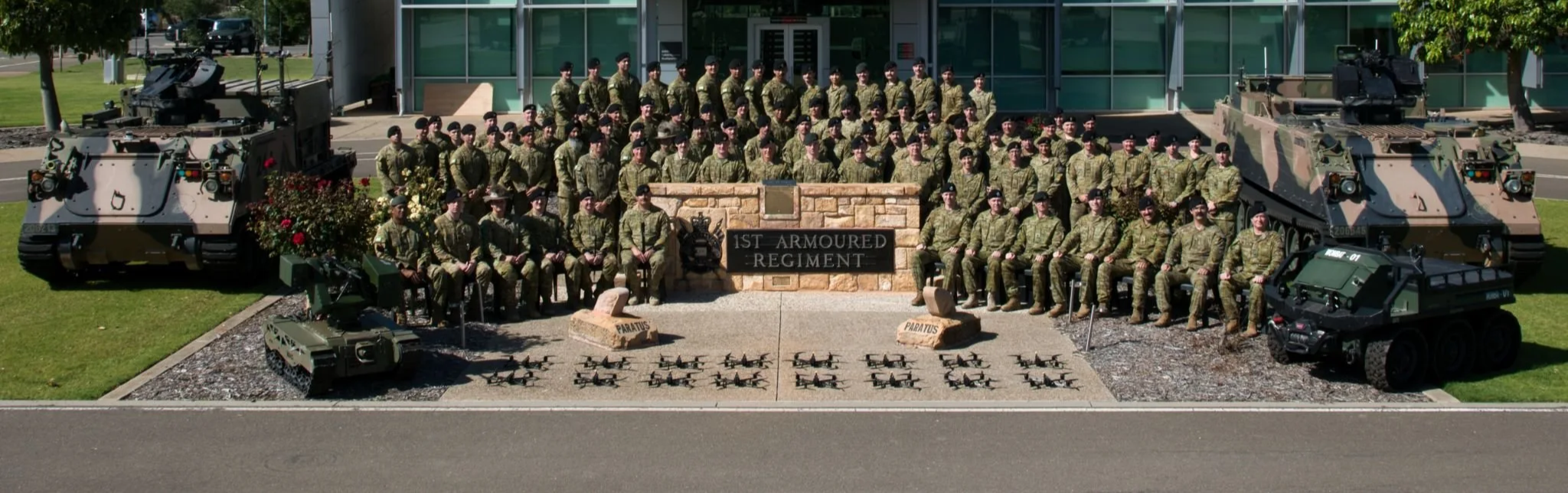
1st Armoured Regiment with tracked and Wheeled UGVs (image coutesy of Defence Australia)