A Shelf-Ready Autonomy Kit for Defence Surge
Cyborg have been developing and integrating platforms for 8 years across land, sea and air. Over this time we have worked on high price point platforms with all the bells and whistles, designed to protect 10 million dollar pieces of infrastructure, and low cost systems designed to achieve cost kill ratios required to win a long term war based off economics from cost kill ratios.
Each one of these platforms developed also carries additional burdens of spare parts supply, maintenance, training, repair in combat etc. In doing so any peacetime military in a time of strategic relevance faces a budgeting dilemma, how do you achieve operational surge without overcommitting resources that require 2x the acquisition cost to sustain throughout their life?
Civilian Sector Platform Pricing
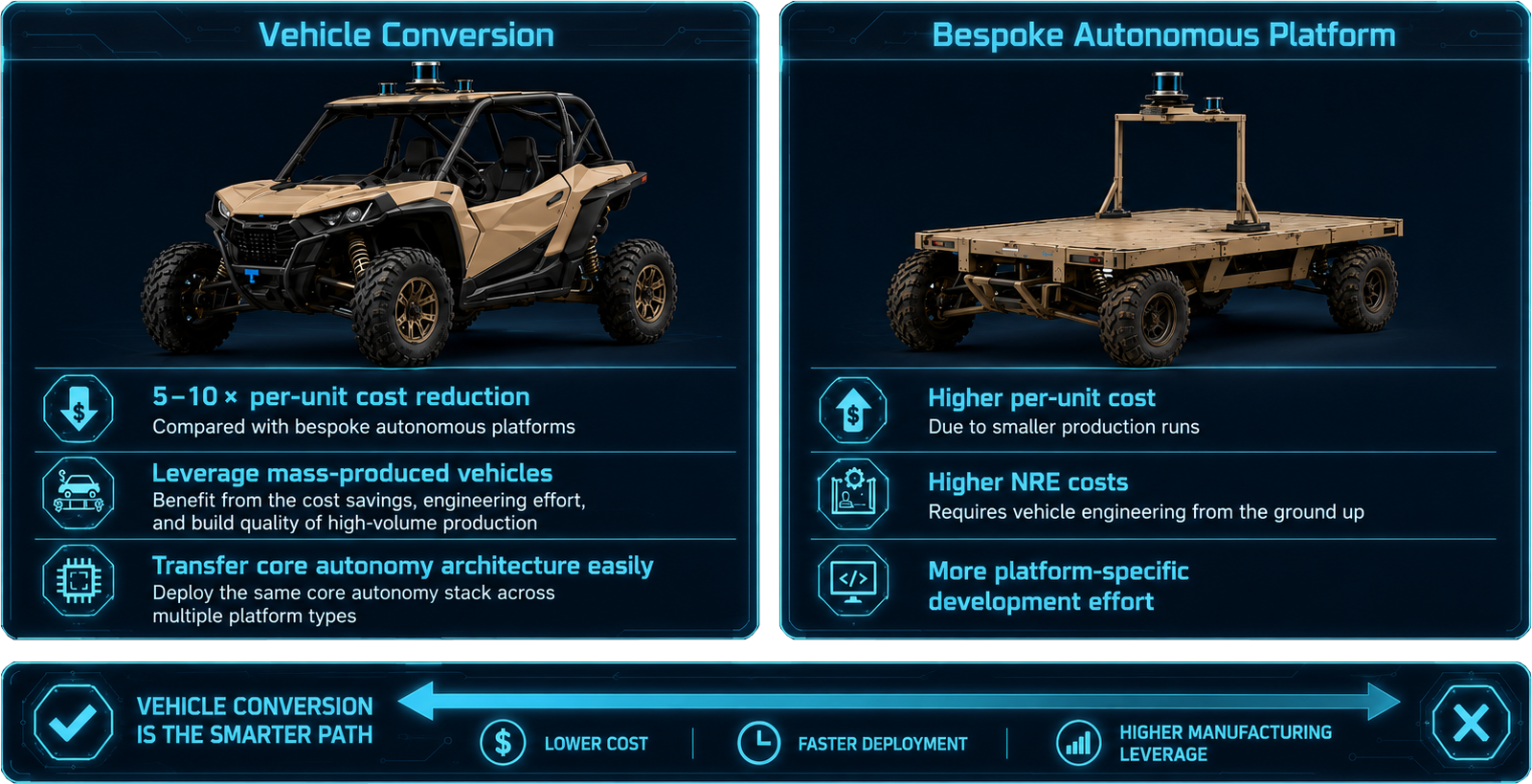
Consider a Jetski or a Polaris 4 x 4. These platforms are $10,000-$15,000 new, vs $40,000+ for SMEs to produce simple, bespoke platforms with far less payload. These platforms carry large payloads rated for multiple people, are highly tested, have significant spare parts availability, and mechanics trained to already service them. They sit in the civilian sector with a new and second hand supply chain that is extensive and distributed for resilience, and new systems can even be built from the spare parts in most cases.
Universal Autonomy Kit
The answer may be in generalized autonomy kits. Given that a baseline teleops (RC controlled) robotics pack combined with GPS navigation and a radio is in the order of tens of thousands, vs platforms pushing into hundreds of thousands of dollars, a base autonomy pack could allow for surge massing during early stages of a conflict.
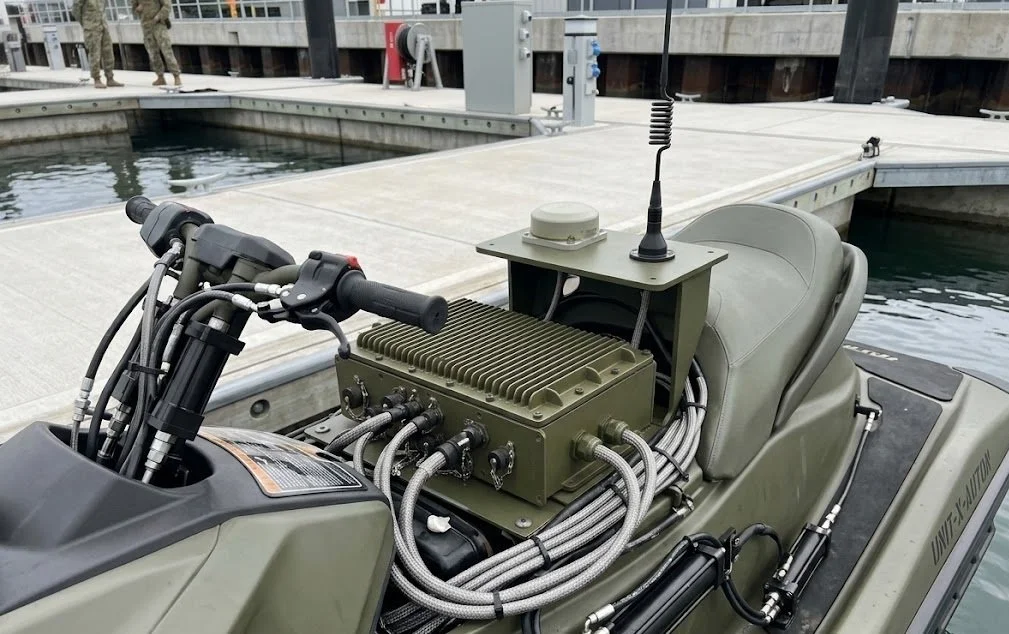
These autonomy packs could be retrofitted on jetskis, Polaris off road vehicles (or electric equivalents), outboard motor tin boats and light aircraft such as what we have seen with Jericho’s Project Camel Train.
Polaris with autonomy has proven to be highly successful in Ukraine by Forterra, with simple teleoperations providing high levels of utility.
Furthermore fast boats retrofitted with explosives formed the basis of initial long range maritime strikes in the Sea of Azov in the early stages of the Ukraine war.
Baseline Autonomy Capability
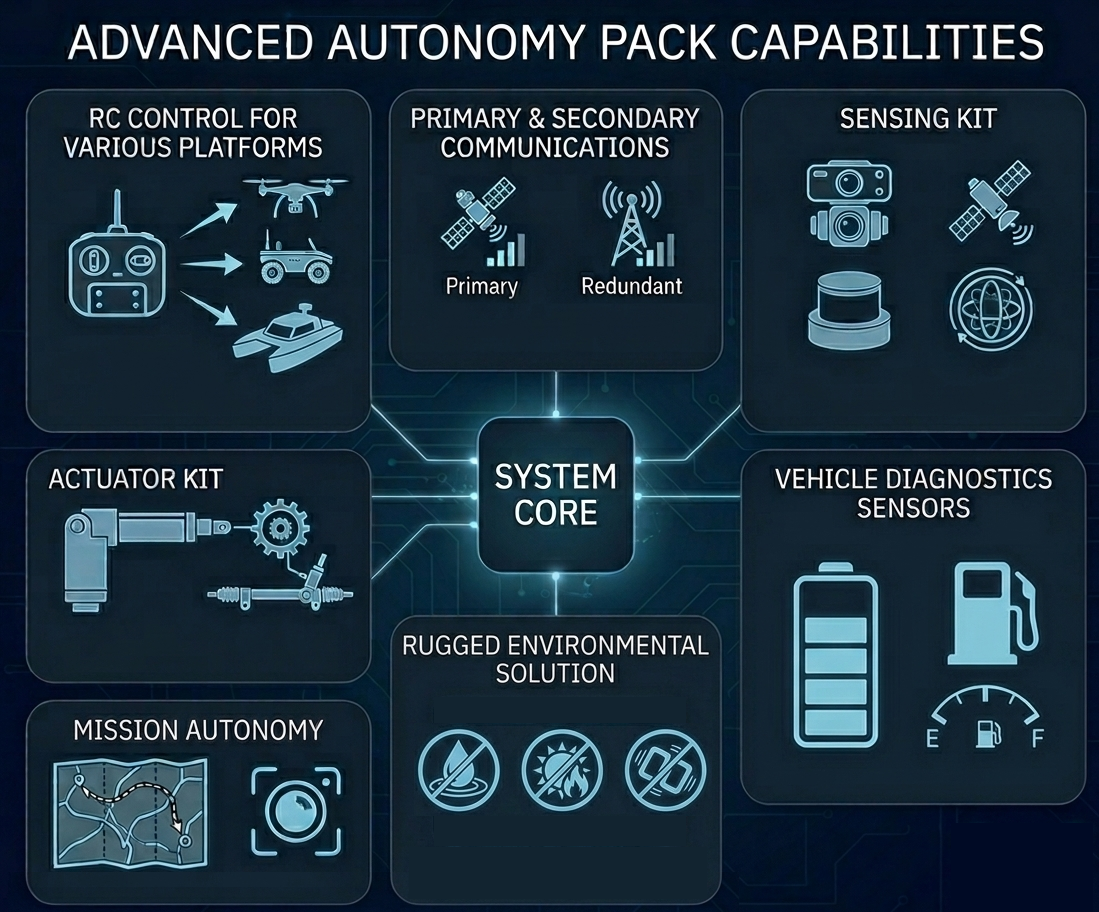
So what does a generic autonomy stack look like. Well in software it is likely:
RC control for various platform types
Primary and secondary communications
Sensing kit including cameras, collision avoidance, GPS, Internal Sensors
Actuator kit or controlling throttle, steering etc.
Vehicle diagnostics sensors such as fuel level, battery level.
Optional mission autonomy for when communications are jammed (e.g. terminal guidance)
User interface with multi platform control capabilities such as ROS node on platform
The actuator kit, sensor placement, and specific vehicle diagnostics would vary for each system, with some custom brackets possibly required for mounting, but these would be very simple tasks that could be performed by military maintenance units for instance.
Now this approach does not solve all use cases, and these systems would remain vulnerable to direct fire, likely requiring countermeasures such as EW jammers etc. and hardening around key components (engines and controller).
What Domains of Warfighting Remain Unaddressed with this Approach
Long range missiles.
Air Defence
Underwater warfare
Challenging terrain
The reality is that highly specialized platforms and use cases do not have civilian equivalent platforms that can be converted. Whether this is systems requiring high levels of protection or exposed to extreme operating conditions such as deep-sea missions and 1000+ mile strikes. There is no way around these procurements, and fundamentally they require both sovereign manufacturing and deep magazine depth.
Summary
The assessment is that light aircraft, small rigid hull boats and jetskis, and small off road vehicles could all be used as a low cost surge capability for modern warfighting at a significantly lower cost than bespoke platforms. Ukraine has proven the utility of this, and having generic autonomy kits on the shelf would allow a defence force to then procure the platforms for a specific operation on a case by case basis, without the maintenance and through life support burden from platform sustainment.